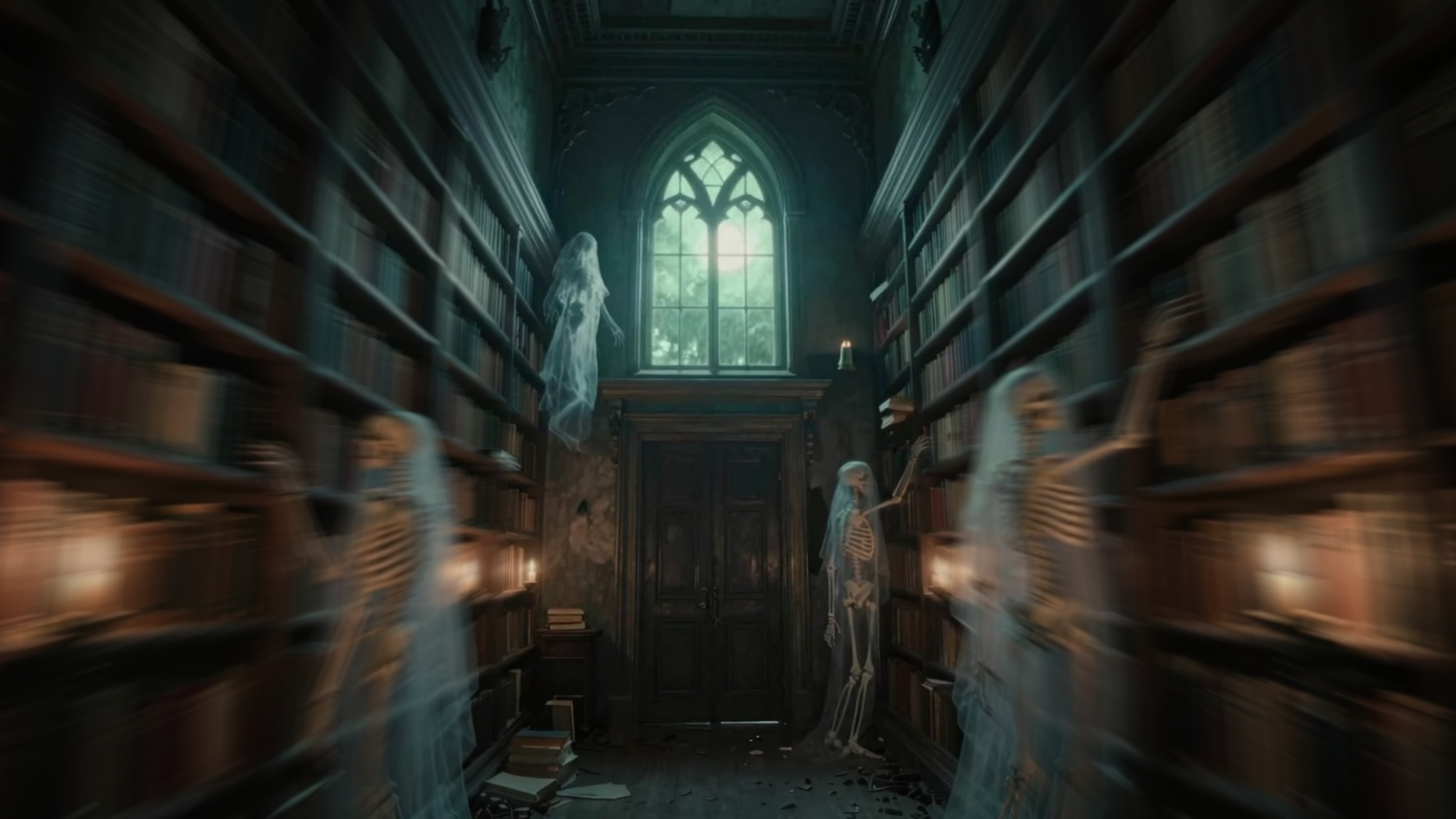
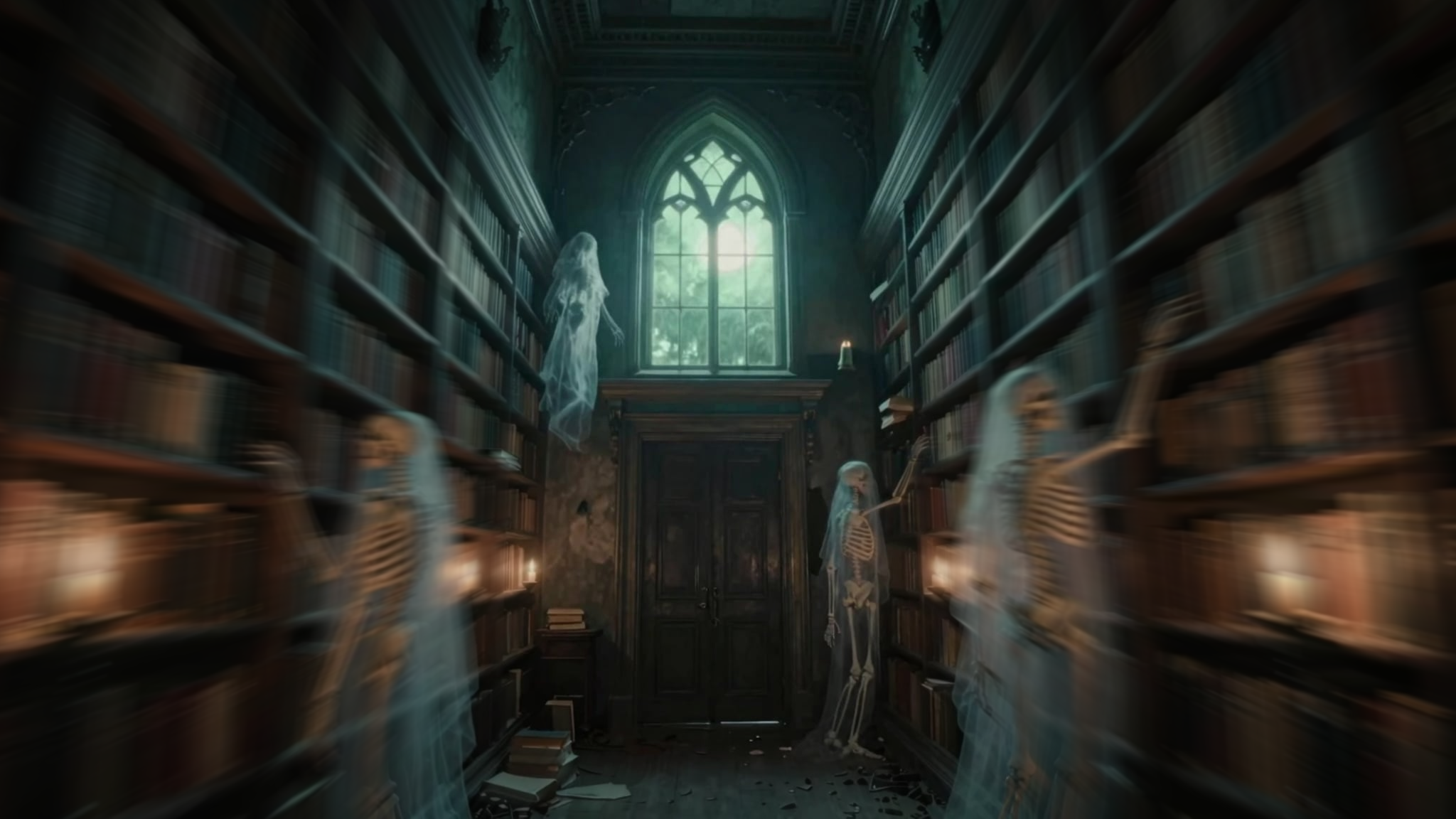
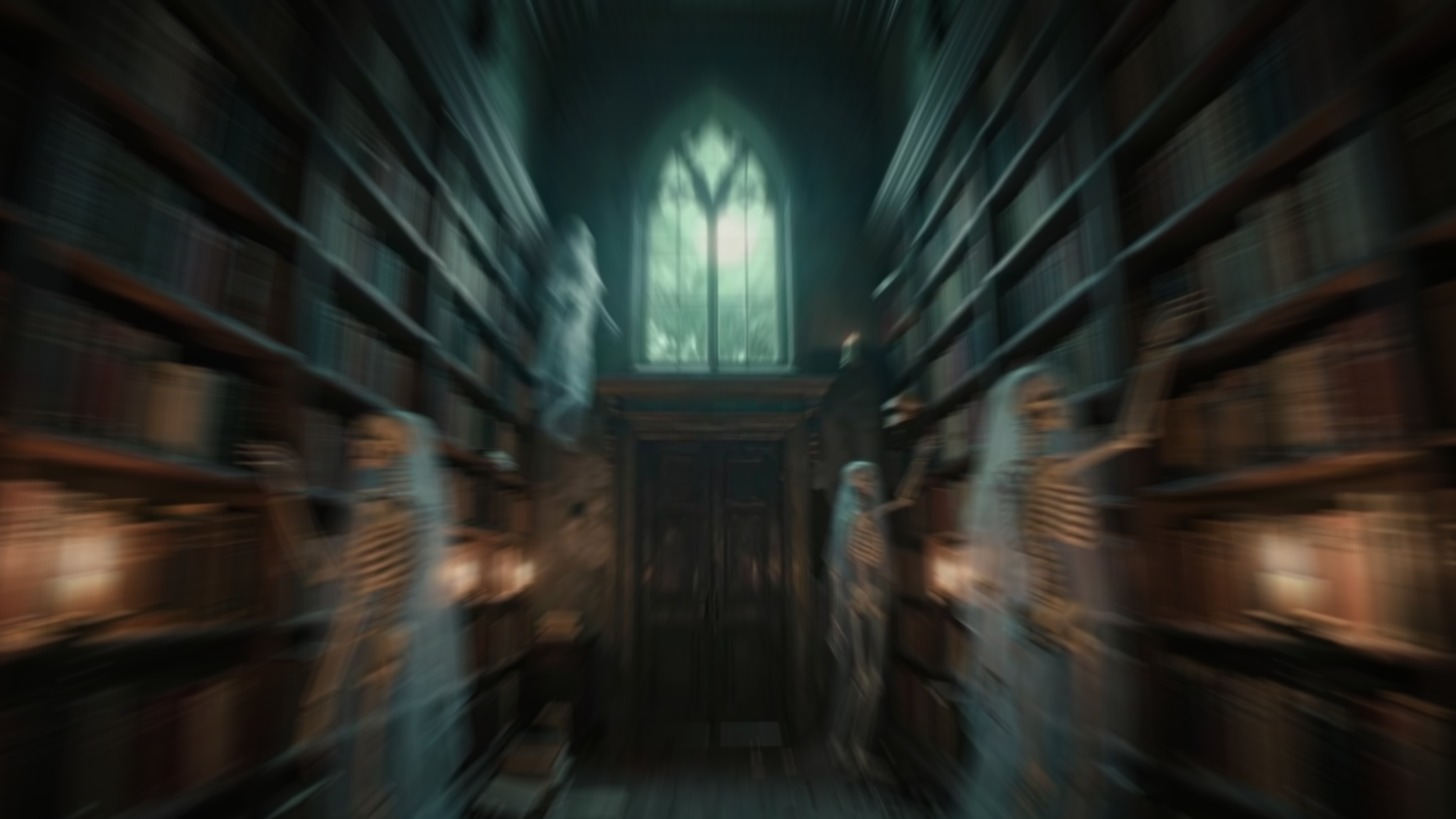
We now read the Action as depth-banded compositing, not one continuous depth-scaled radial blur.
This entry is a chronological research record. The Markdown docs remain current architecture. Camotion code, tests, and CameraMotionPlan v1 are unchanged. Terran Boylan originated TunnelVision as a manual filmmaking technique; this research extends it into an agentic system. Camotion is not a port of Terran’s Photoshop Action. Interpretations and hypotheses below are ours, not claims Terran made.
What we believed going in
By 31 August 2026, optional near-weight scaling had improved the Ghost Library still, especially far-field stability, but video generation still produced a recursive / reconstructed-space effect. Direct comparison with Terran’s original TunnelVision Ghost Library motion frame showed similarly strong near-field motion and stable distant architecture. That weakened the hypothesis that depth weighting itself caused the recursion. We stopped speculative renderer work and asked Terran for higher-authority evidence of the original Action.
Known ingredient, then a still-image win
PRIOR RESULT
Depth was already a known ingredient of Terran’s original TunnelVision workflow. The 01.4 Ghost Library still applied a continuous near-weight multiplier to Camotion’s radial field. Relative to radial-only 01.3, distant architecture such as the gothic window stayed substantially more stable. At the still-image level, depth weighting looked like the right next variable.
Video still reconstructed the space
UNRESOLVED ARTIFACT
Video-generation tests from depth-weighted shooting frames still showed the strange recursive / reconstituted-library behavior. A control without an extra pristine reference still did. At that point it was easy to suspect that our new depth path was the cause.
Terran’s original frame weakened that suspicion
HYPOTHESIS WEAKENED
Terran’s original Ghost Library motion-conditioned frame also uses strong near-field motion and keeps far architecture comparatively sharp. Depth-aware motion itself is consistent with the original technique. The remaining open question was the character of Camotion’s continuously depth-scaled radial exposure versus whatever Terran’s Action actually did.
Stop guessing. Obtain the Action.
DECISION
We deliberately stopped speculative renderer changes. Terran supplied the original Photoshop .ATN from his TunnelVision motion-conditioning workflow, stored as camotion/tuning/Auto-3D-Radial-Blur-Save-Close.ATN.
Binary forensics, then ActionJSON
EVIDENCE
primary export: camotion/tuning/async function auto3DRadialBlurSave.json
Binary inspection of the .ATN showed Photoshop Neural Filter depth processing, multiple Radial Blur operations, Gaussian Blur, inversion, Levels, masks/selections, layer duplication/compositing, and merge/save/close. Before reverse engineering had to proceed entirely from the binary, Terran supplied a Photoshop batchPlay / ActionJSON-style export. That JSON is the primary evidence for the meaningful image-processing sequence.
The embedded Neural Filter graph includes depth-related nodes such as depthMapProviderV2Local, Depth_Estimation, and Depth_Estimation_Refinement2. The important architectural fact is that Photoshop generates and refines a depth representation. The graph itself is not documented exhaustively here.
Observed layer/mask sequence
ACTION OBSERVATION
From the JSON, the meaningful stack is approximately:
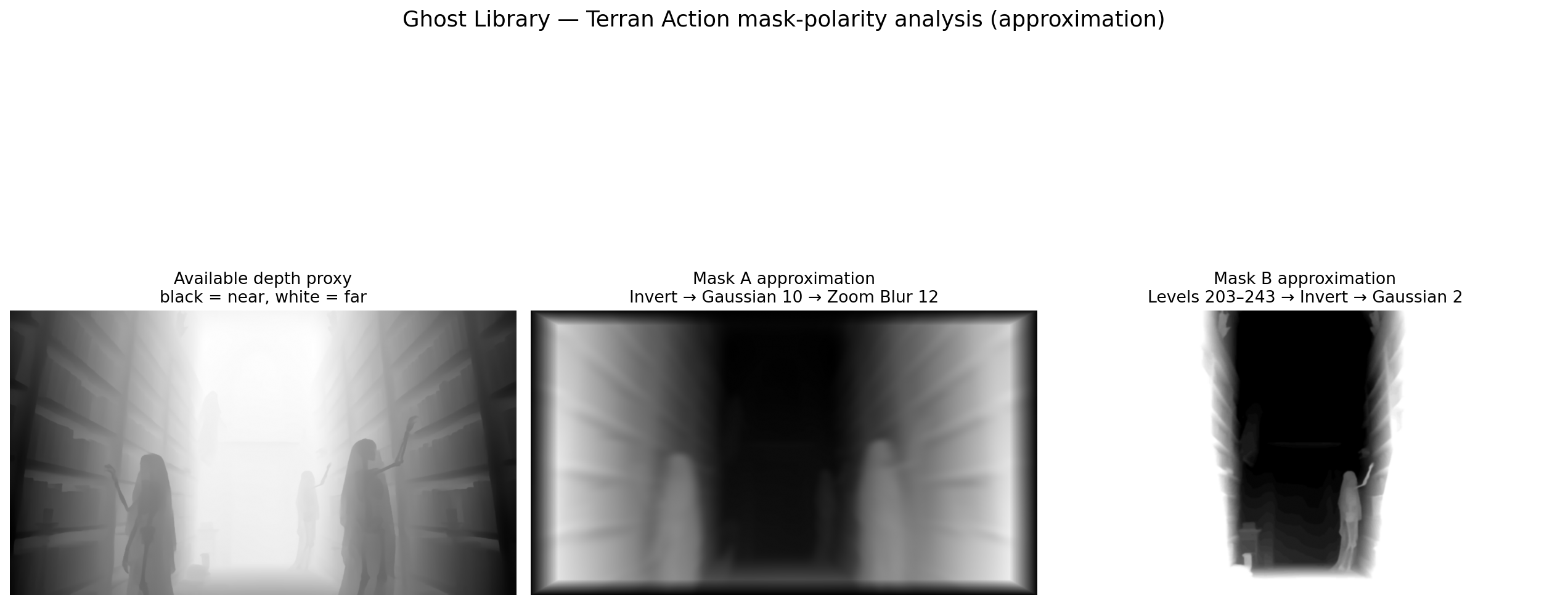
Background copy — image = Zoom Blur 12 (method Zoom, quality Best, center 0.5, 0.5). Mask = Neural Filter depth, then Invert, Gaussian Blur radius 10, then the same Zoom Blur 12.
Background copy 2 — image = Zoom Blur 8 (same method/quality/center). Mask = a second Neural Filter depth from the pristine source, then Levels composite input [203, 243], Invert, Gaussian Blur radius 2.
Background — pristine source, underneath.
Photoshop then selects/merges, saves, and closes. This is an observation of Terran’s Action, not a Camotion implementation plan.
Major discovery: two exposures, not one scaled blur
REVISED MODEL
Terran’s result is better understood as Blur-12 + Blur-8 + pristine, composited through depth-derived masks, than as one continuously depth-scaled radial blur. Interpretation (ours): depth-banded, motion-aware exposure compositing. Near: Blur 12 dominates. Mid: Blur 12 fades, Blur 8 remains. Far: Blur 8 fades, pristine increasingly dominates.
Stronger discovery: the strong mask is itself zoom-blurred
REVISED MODEL
Current Camotion approximately does radial_motion(x,y) × depth_weight(x,y), so the depth weighting stays spatially tied to original geometry. Terran’s Action instead approximately composites a motion-treated image through a motion-treated depth visibility mask. The boundary that controls where the blurred exposure contributes is itself spread along the exposure path.
Hypothesis (ours, unproven in Camotion): this may help depth boundaries read as integrated photographic motion rather than stretched/warped scene geometry.
Mask polarity (analysis, not a Terran claim)
INTERPRETATION
Available evidence supports reading the Action’s working depth as approximately black = near, white = far — the same polarity as our Ghost Library depth proxy before we invert it for Camotion’s near-weight convention. After Invert, the strong mask is approximately white near / black far. Photoshop layer masks reveal with white, so Blur 12 dominates near geometry and disappears with depth. After Levels [203, 243] and Invert, the medium mask approximately reveals Blur 8 over near/mid geometry and suppresses it over the furthest range.
Diagnostic approximation, not a faithful reconstruction. This PNG is not Photoshop’s Neural Filter depth output, not Photoshop Radial Blur, not a pixel-faithful recreation of Terran’s Action, and not a Camotion renderer result. It exists only to reason about mask polarity and spatial behavior using the existing Ghost Library depth proxy and an approximate zoom-blur implementation.
Revised hypothesis for the recursive-space artifact
HYPOTHESIS
The recursive-space issue may relate to the character of Camotion’s current continuously depth-scaled radial exposure/warping, while Terran’s layered, motion-aware mask treatment may produce a more photographic conditioning signal. This has not been proven. It replaces the weaker “depth weighting caused the recursion” hypothesis, which Terran’s original frame had already made less convincing.
Checkpoint decision
ATN / ActionJSON forensics are complete enough to stop reverse engineering and begin a controlled Camotion renderer experiment. That experiment is not implemented in this checkpoint.
Next test: whether deterministic depth-banded + motion-aware + multi-exposure compositing produces a more photographic and generative-video-legible shooting frame than the current continuous depth-multiplier renderer. Treat it as an experimental path, not a replacement. Compare against the existing Ghost Library fixture before any renderer replacement decision.
Preserve Camotion / TunnelVision extensions Terran’s Action did not have: Cinematographer-selected vanishing point rather than a fixed Photoshop center of 0.5, 0.5; destination protection; external/interchangeable depth; normalized geometry; deterministic/testable processing; later, context-aware parameters rather than permanently hardcoded 12 / 8 / 203–243.
Do not change CameraMotionPlan v1. Do not add Photoshop fields to the plan. Do not move depth estimation into Camotion. Do not add Neural Filters. Do not implement B_in/B_out, turning/yaw/strafe, or video-architecture changes. Do not remove the current continuous near-weight path.
Intended order after this record: controlled Camotion renderer experiment → validate/freeze an updated baseline if justified → Automated Cinematographer + Camotion Benchmark Harness → cross-style / cross-model experiments.
Split of labor unchanged: agent reasons → CV observes/measures → Camotion renders → video model films.
DEPTH-BANDED COMPOSITOR · SEPTEMBER 2, 2026
Ghost Library 01.5 reduced recursive reconstruction. It did not eliminate it.
This entry is a chronological research record after the Terran Action checkpoint. The Markdown docs remain current architecture. CameraMotionPlan v1 and default render() were not changed. The experimental compositor is not a frozen baseline. Interpretations below are ours, not claims Terran Boylan made. Terran originated TunnelVision as a manual technique; this research is the agentic extension.
What we believed going in
ATN / ActionJSON reverse engineering suggested Terran’s result was depth-banded, motion-aware compositing, including Zoom Blur on the strong depth mask itself. We hypothesized that a Camotion experiment with that structure might be more photographic and more generative-video-legible than continuously depth-scaled radial exposure. That had not been tested.
Experimental path, default renderer left alone
METHOD
We implemented a controlled experimental renderer without changing normal render() or CameraMotionPlan v1. It reuses existing radial multisample exposure at two strengths: a strong branch at the plan’s exposure.strength, and a medium branch at that strength × 8/12.
A near/mid mask, derived from Camotion near_weight (white=near), controls the medium branch. A Gaussian-softened strong depth mask is itself passed through the same radial exposure before controlling the strong branch. Layers composite over pristine source; existing destination protection is applied last.
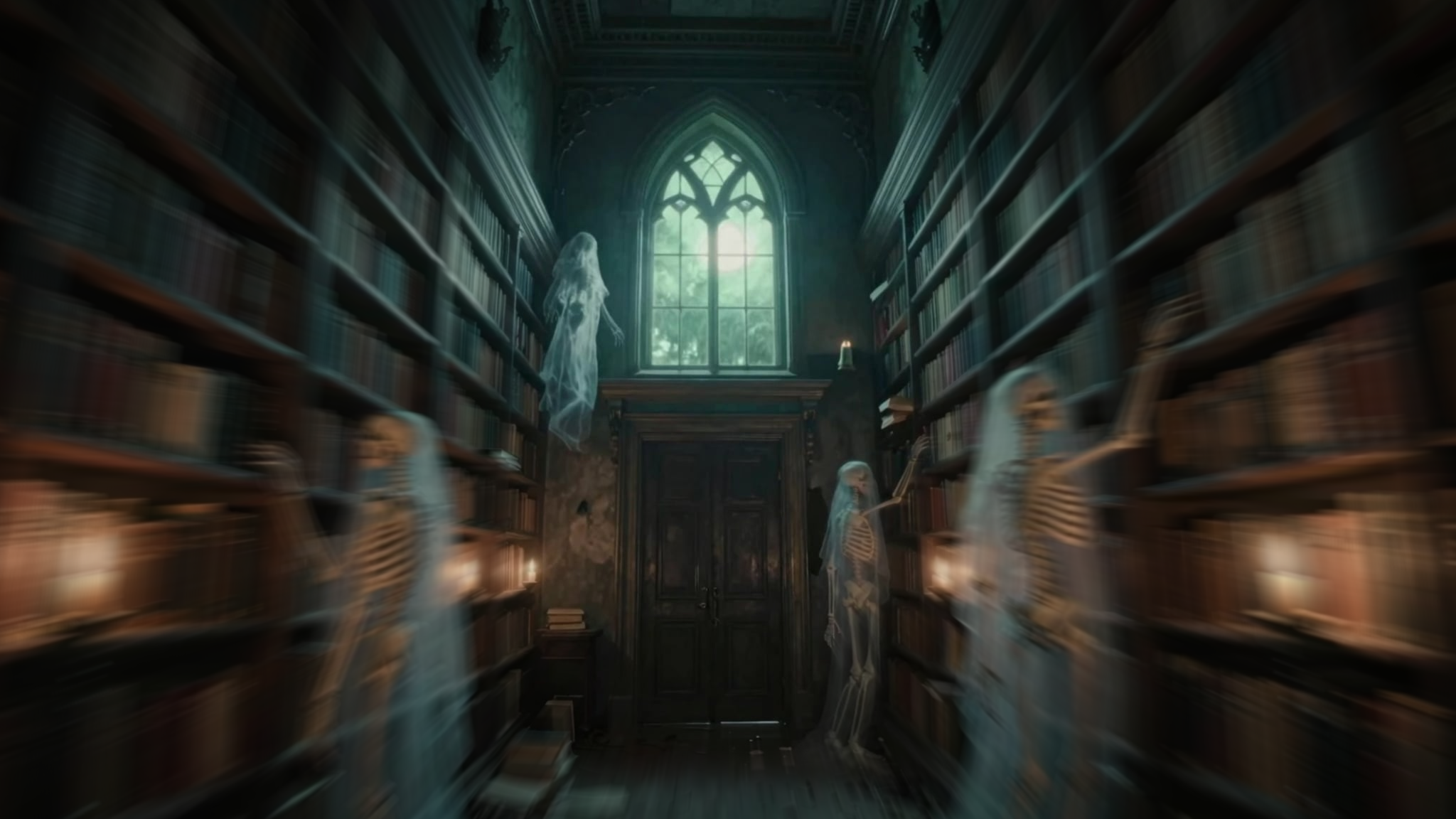
Ghost Library still 01.5
STILL LOOKS MORE PHOTOGRAPHIC
camotion/tuning/01.5-banded-result.png · same 01.4 plan · 01-depth.png as white=near near_weight · not a frozen baseline
Experimental comparison still, not a new production baseline. Qualitatively: strong near-shelf/figure motion, intermediate mid-depth motion, stable far architecture, a spatially legible doorway/window, receding shelves that read more like continuous depth than radially stretched geometry. Visual quality is not a mathematical proof.
camotion/tuning/01.5-banded-video.mp4 · same general locomotion setup as the prior Ghost Library test · one fixture
The previous 01.4-era generation showed substantial recursive/reconstructed-space behavior across roughly the first 1–3 seconds. With the 01.5 banded shooting frame, that pathology was materially reduced. The generated shot remains recognizably within one library space through most of the early traversal, reaches the doorway, crosses the threshold, and continues into the courtyard.
On the Ghost Library fixture, the depth-banded, motion-aware compositor produced a more photographic shooting frame and materially reduced the recursive-space reconstruction seen in the previous video-generation experiment. A shorter reconstruction artifact remained during approximately the first second.
Not solved
PARTIAL SUCCESS
The problem is not eliminated. Recursion is not solved. 01.5 is not universally better, not validated across scenes, and is not a permanent replacement for the continuous near_weight renderer. Terran’s method did not “directly solve” the problem. This is one fixture and one generated comparison.
Revised next hypothesis
HYPOTHESIS
Supporting evidence: depth-banded, motion-aware compositing may be a more legible motion-conditioning representation for generative video than continuously depth-scaled radial exposure. Stronger than a still-only hypothesis because the video also improved. Still provisional.
The remaining first-second reconstruction suggests a narrower question: temporal orientation of the start shooting frame. Current outgoing exposure is canonical A → displaced exposure history. For a start frame, the video model may instead benefit from displaced history that terminates at canonical A. Do not treat this as B_in/B_out architecture yet.
The next controlled experiment should change only that start-frame orientation, holding the depth-banded compositor, depth, strengths, masks, destination, locomotion prompt, video settings, and end shooting frame as constant as practical. Not implemented in this checkpoint.
Checkpoint decision
Checkpoint the depth-banded experiment before testing temporal orientation. Default Camotion remains the continuous near-weight path. CameraMotionPlan v1 stays frozen.
This entry is a chronological research record after the 01.5 depth-banded compositor checkpoint. Previous history is unchanged. The Markdown docs remain current architecture. CameraMotionPlan v1 and default render() were not changed. Interpretations below are ours, not claims Terran Boylan made. Terran originated TunnelVision as a manual technique; this research is the agentic extension.
What we believed going in
01.5 outgoing start exposure materially reduced, but did not eliminate, recursive-space reconstruction. The remaining first-second artifact suggested that the start shooting frame might encode the wrong temporal orientation: canonical A as the origin of an outgoing trail, rather than the terminal/current position with motion history behind it. That was a hypothesis, not architecture.
One-variable A/B
METHOD
Control: Ghost Library 01.5 outgoing start frame plus the previously used end shooting frame, locomotion prompt, and video settings. Experiment: the same 01.5 compositor, plan, depth, strengths, masks, destination protection, and end frame; only the start-frame sample set changed from p − field·t to p + field·t. Strong image, medium image, and strong mask shared that orientation. Medium-mask construction was not changed. Reversing Python loop order would not have changed the image; the sample-position set was reversed.
The experimental helper remains in code as evidence. It is not CameraMotionPlan, not default render(), and not A_in/A_out or B_in/B_out architecture.
Ghost Library still 01.6
OPPOSITE TRAIL GEOMETRY
camotion/tuning/01.6-terminal-start-result.png · same 01.4 plan and 01-depth.png as 01.5 · only exposure orientation changed
Same compositor and inputs as 01.5; exposure history terminates at canonical A. Visual smear amount is similar, trails sit on the opposite side of geometry. Diagnostic abs-diff: tuning/analysis/01.6-vs-01.5-absdiff.png.
Corresponding Seedance traversal
WORSE INITIAL RECONSTRUCTION
camotion/tuning/01.6-terminal-start-video.mp4 · same previous end shooting frame, locomotion prompt, and duration/settings as the 01.5 video test · one fixture
On the Ghost Library fixture, reversing the start shooting frame’s exposure orientation so that exposure history terminates at canonical A worsened the initial spatial reconstruction. The video showed a stronger initial collapse/retreat and subsequent reconstruction before establishing coherent forward traversal.
Hypothesis rejected on this fixture
REJECTED
Reject terminal-at-canonical start exposure as the working hypothesis here. Retain the 01.5 outgoing exposure orientation as the current Camotion research baseline. Do not claim universal cross-scene validation. Do not remove the experimental implementation or evidence. Do not tune 01.6. Do not introduce A_in/A_out or B_in/B_out architecture. Do not start another experiment from this record.
The negative result is useful: start-frame temporal orientation is causally relevant to the initial reconstruction on this fixture, and the outgoing 01.5 orientation is the better of the two tested directions.
Checkpoint decision
Keep 01.5 outgoing orientation as the working experimental baseline. Default Camotion remains the continuous near-weight path. CameraMotionPlan v1 stays frozen. Stop here; do not begin the next renderer experiment in this checkpoint.
REDUCED STRENGTH · SEPTEMBER 3, 2026
Halving start-frame strength removed obvious recursion and weakened source-geometry authority.
This entry is a chronological research record after the 01.6 temporal-orientation checkpoint. Previous history is unchanged. The Markdown docs remain current architecture. CameraMotionPlan v1 and default render() were not changed. Interpretations below are ours, not claims Terran Boylan made. Terran originated TunnelVision as a manual technique; this research is the agentic extension.
What we believed going in
01.5 outgoing depth-banded exposure at strength 0.08 remained the working Ghost Library baseline after 01.6 rejected terminal-at-canonical orientation. A brief first-second reconstruction still remained. The next one-variable hypothesis was that the start shooting frame was over-conditioned: too much motion-exposure strength might be causing Seedance 2.5 to reconstruct space at the beginning of the shot.
One-variable A/B
METHOD
Control: 01.5 depth-banded outgoing start frame, strength 0.08. Experiment: the same compositor, Ghost Library source, near_weight, outgoing orientation, medium/strong ratio 8/12, masks, softening, vanishing point, destination protection, sample count, previously used end shooting frame, locomotion prompt, and Seedance 2.5 settings. Only start-frame exposure.strength changed to 0.04. No new plan fields. Fixture: tuning/01.7-banded-strength-004-plan.json.
Ghost Library still 01.7
WEAKER PERIPHERAL EXPOSURE
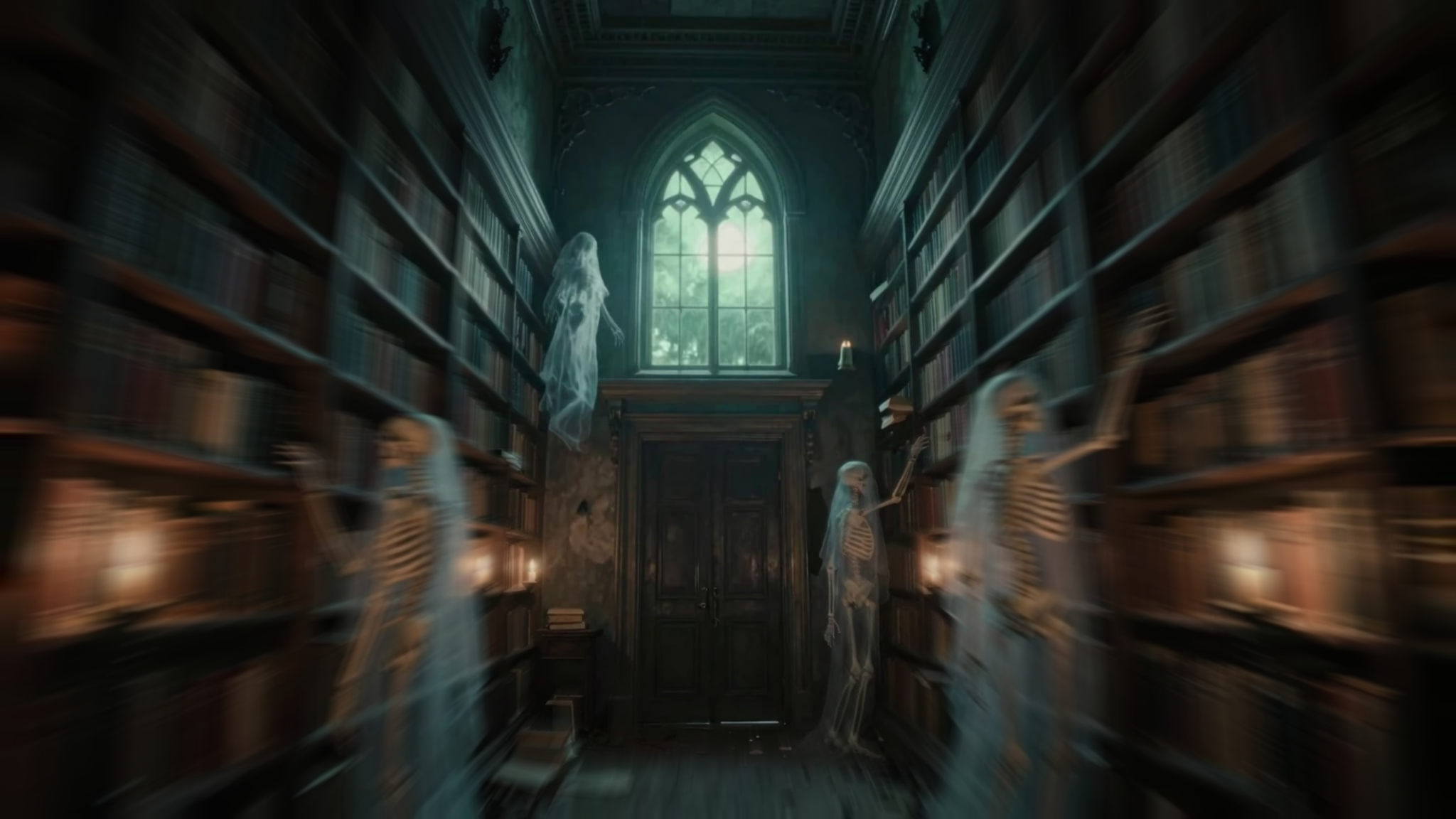
camotion/tuning/01.7-banded-strength-004-result.png · same 01.jpeg and 01-depth.png as 01.5 · outgoing p − field·t · strength 0.04
Same 01.5 path at half exposure strength. Peripheral smear is weaker; central architecture remains protected. Visual still-quality is not a video-generation verdict.
Corresponding Seedance 2.5 traversal
TRADEOFF, NOT A PROMOTION
camotion/tuning/01.7-banded-strength-004-video.mp4 · same previous end shooting frame, locomotion prompt, and Seedance 2.5 settings as the 01.5 video test · one fixture
01.7 removed the obvious initial recursive/reconstructed-space event seen in 01.5. That is not simply a success. Seedance immediately reinterpreted/warped the starting spatial geometry more substantially. The generated library became a different/narrower inferred corridor rather than preserving the authored starting geometry as closely as directed A→B requires. Later forward traversal and doorway crossing remained coherent.
0.04 is not the new baseline
NOT PROMOTED
Do not describe 01.7 simply as worse, and do not promote it because recursion disappeared. On this Ghost Library / Seedance 2.5 fixture, conditioning strength appears to trade off reconstruction behavior against source-geometry authority. Weaker start-frame exposure reduced obvious recursion and also reduced authority over the authored start.
For directed A→B traversal, the conditioned start and end frames are authoritative shot endpoints. Generated boundary frames should match those supplied endpoints as closely as the video model permits, ideally pixel-perfect. Evaluation priority: endpoint fidelity, then coherent spatial traversal, then locomotion/parallax quality; creative scene evolution must not violate endpoint authority. That requirement is specific to directed A→B. Future Discovery / open-exploration generation may invent future geometry after an authoritative starting frame; that mode is not this experiment and is not current architecture.
Retain 01.5 / 0.08 as the current working baseline for directed A→B research. One fixture, one video model. No universal claim.
Checkpoint decision
Keep 01.5 outgoing exposure at strength 0.08 as the directed A→B working baseline. Keep the 01.7 plan, still, and video as evidence of the tradeoff. Default Camotion remains the continuous near-weight path. CameraMotionPlan v1 stays frozen. Stop here; do not begin the next renderer experiment in this checkpoint.
ROUTE PRESERVATION · SEPTEMBER 3, 2026
Route-preserved 0.08 exposure kept peripheral motion and clarified the central corridor. Seedance later opened backward, then went forward.
This entry is a chronological research record after the 01.7 reduced-strength checkpoint. Previous history is unchanged. The Markdown docs remain current architecture. CameraMotionPlan v1 and default render() were not changed. Interpretations below are ours, not claims Terran Boylan made. Terran originated TunnelVision as a manual technique; this research is the agentic extension.
What we believed going in
01.5 outgoing depth-banded exposure at strength 0.08 remained the video-tested Ghost Library / Seedance 2.5 baseline. 01.7 showed that globally halving strength to 0.04 removed obvious initial recursion but weakened source-geometry authority, so 0.04 was not promoted. The next hypothesis was spatial rather than another global strength cut: keep the stronger 0.08 cue in the periphery, and attenuate exposure along a soft geometric traversal corridor so more canonical route geometry remains.
One-variable spatial modifier
METHOD
Control: 01.5 depth-banded outgoing start frame, strength 0.08. Experiment: the same compositor, Ghost Library source, near_weight, outgoing orientation, medium/strong ratio 8/12, masks, softening, vanishing point, destination protection, and sample count. Only change: an experimental route-preservation corridor, off by default on the 01.5 path. Strength stayed 0.08. No CameraMotionPlan fields. No segmentation, depth model, or LLM. Fixture metadata: tuning/01.8-route-preserved-config.json.
The corridor is a deterministic perspective wedge from the vanishing point through the destination: narrower near the vanishing point, wider toward the foreground, soft-feathered. Existing strong/medium visibility is multiplied by (1 − 0.70 × corridor_mask). Destination protection still runs afterward, separately. Parameters used: top width 0.14, bottom width 0.48, feather 0.10, preservation strength 0.70.
Route-preservation mask
DIAGNOSTIC
camotion/tuning/analysis/01.8-route-preservation-mask.png · white = preserve canonical route · black = retain 01.5 motion treatment
Perspective corridor used to attenuate exposure along the route. Not CameraMotionPlan. Not product architecture.
Ghost Library still 01.8
STILL-LEVEL, NOT A VIDEO VERDICT
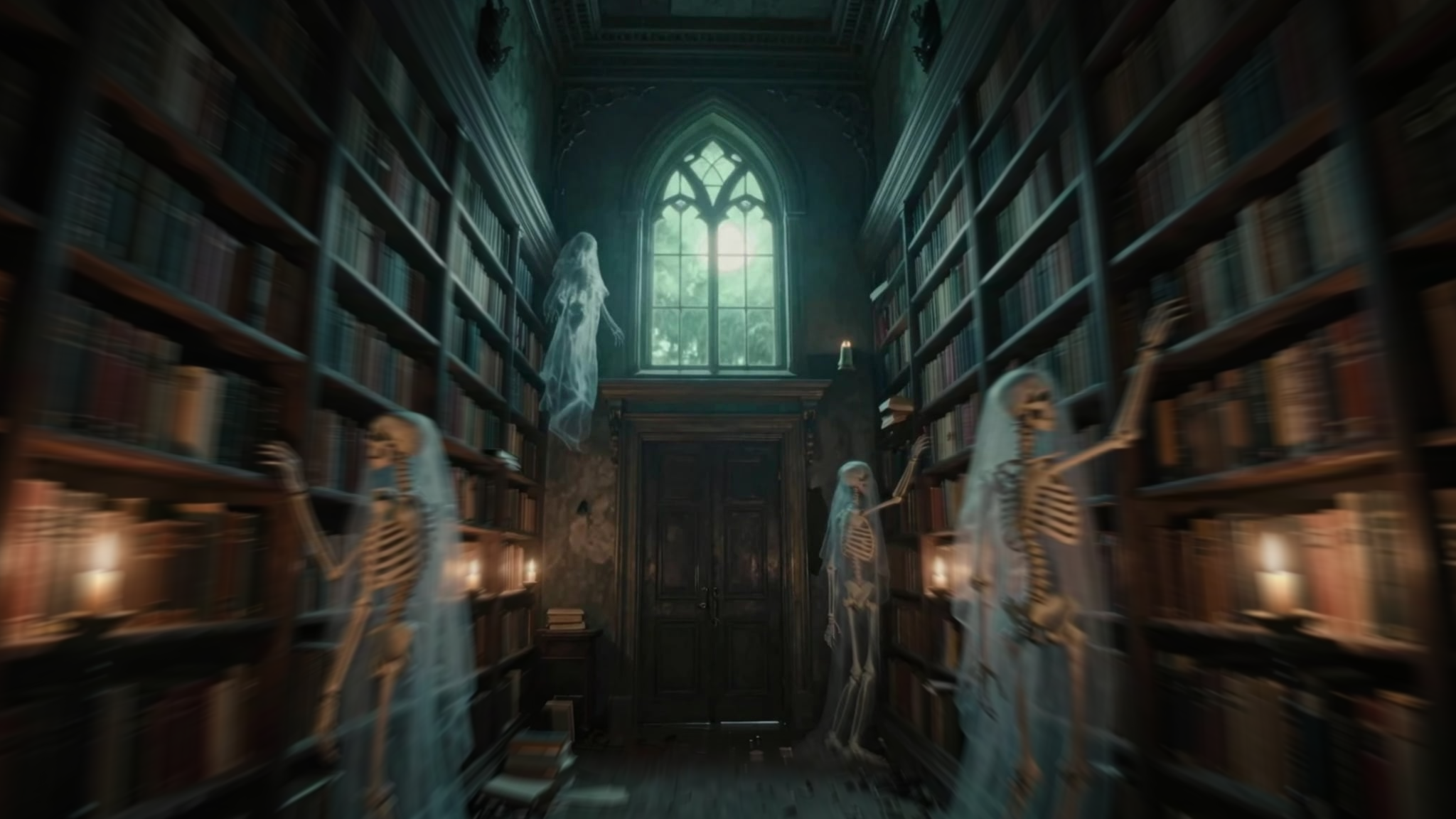
camotion/tuning/01.8-route-preserved-result.png · same 01.4 plan and 01-depth.png as 01.5 · outgoing p − field·t · strength 0.08 · route preservation on
Peripheral smear remains strong. The central aisle and door read more like the canonical route. Not a Seedance result.
Visual inspection: 01.8 retained strong peripheral motion treatment, preserved more recognizable canonical geometry through the central traversal corridor, and did not merely reduce global exposure. Some compact central objects, especially mid-field candles, looked more like a single object with continuous blur. In 01.5 those candles had appeared as discrete doubled or repeated instances. That is an observation. A useful later-research hypothesis is that discrete multi-sample ghosting of compact high-contrast features may be interpreted differently by a video model than continuous-looking motion blur. That is not proven, and it is not claimed to have caused any video behavior.
Comparison with Terran's original Ghost Library frame
SPATIAL, NOT AN OPTIMIZATION TARGET
01.5 and 01.8 were compared against Terran Boylan's original TunnelVision-conditioned Ghost Library reference. The images matched in dimensions, so the comparison was registered. 01.8 moved somewhat closer globally, but the more useful result was spatial: the largest improvement was in the central traversal region, while the periphery changed comparatively little. That matches the intended intervention.
Do not treat pixel similarity to Terran's image as an optimization target. Different blur kernels, Photoshop behavior, interpolation, and color handling can change pixels without changing the usefulness of the conditioning cue. Closer pixels are not the same as better Camotion.
Transient Krea rejections were not a 01.8 result
OPERATIONAL CONTEXT
Krea initially rejected 01.8 generations multiple times. A subsequent 01.5 control using the same previously usable workflow was also rejected. Those transient rejections therefore could not be attributed to 01.8. Krea later accepted the 01.8 generation. Video validation is not blocked.
Corresponding Seedance 2.5 traversal
OBSERVATION, NOT A PROMOTION
camotion/tuning/01.8-route-preserved-video.mp4 · same previous end shooting frame, locomotion prompt, and Seedance 2.5 / Krea workflow as the 01.5 video test · one fixture
01.8 preserved enough motion conditioning to eventually produce strong forward traversal, but the opening showed an apparent backward/retreat camera movement before transitioning into forward travel. That is materially different from the desired behavior.
Record this as an observation. Do not say 01.8 solved recursion, that 01.8 is better than 01.5, that route preservation causes reverse motion, that the model definitively interpreted the blur backward, that the candles caused the reversal, or that temporal direction ambiguity is proven.
Exposure cues may not fix temporal direction
HYPOTHESIS, UNPROVEN
The result raises the possibility that Camotion’s still-image exposure cues may communicate motion magnitude, motion axis / expansion geometry, and spatial depth/parallax cues without unambiguously communicating temporal direction. A motion-blurred still can be temporally ambiguous. The model may see evidence of motion along an axis without necessarily knowing which end of the exposure trail represents the current instant.
This is especially interesting in relation to 01.6. 01.6 changed exposure orientation and produced a pronounced collapse/retreat/rebuild behavior on Seedance 2.5 via Krea. 01.8 retains 01.5’s outgoing orientation but selectively attenuates conditioning through the central route while retaining stronger peripheral motion treatment. The new backward-then-forward behavior suggests a possible conflict or ambiguity between preserved central route geometry, strongly motion-conditioned peripheral geometry, and temporal interpretation of the exposure cues.
This is a hypothesis only. It may indicate a useful research question. It requires controlled follow-up. It is not a causal claim, and it does not rewrite the 01.5 / 01.6 / 01.7 observations.
01.8 is not the new baseline
NOT PROMOTED
01.8 is a valuable experimental result: the still intervention behaved spatially as intended, central route geometry was better preserved, peripheral conditioning remained strong, compact-object ghosting changed in a potentially meaningful way, and the video exposed a new backward→forward temporal behavior. It is informative, not promoted.
Retain 01.5 / 0.08 / outgoing depth-banded exposure as the current best video-tested directed A→B baseline. One fixture, one video model. No universal claim.
Checkpoint decision
Keep 01.5 / 0.08 as the current video-tested directed A→B baseline. Keep the 01.8 implementation, config, still, route mask, and video as experimental evidence. Route preservation is experimental research code, not CameraMotionPlan and not canonical architecture. Default Camotion remains the continuous near-weight path. CameraMotionPlan v1 stays frozen. A later controlled Replicate series is recorded below. This Krea observation is not retracted. Do not begin 01.9 from this checkpoint.
CONTROLLED REPLICATE SERIES · SEPTEMBER 3, 2026
Same Camotion A′ frames on Replicate Seedance 2.5 did not reproduce the Krea reverse-motion openings.
This entry is a chronological research record after the 01.8 Krea video. Previous history is unchanged. The Markdown docs remain current architecture. CameraMotionPlan v1 and default render() were not changed. Interpretations below are ours, not claims Terran Boylan made.
What we believed going in
Krea Seedance 2.5 videos had associated 01.6 with a severe terminal-orientation collapse/retreat and 01.8 with a pronounced backward-then-forward opening. Those were observations on one provider path. A reusable Replicate MediaProvider and frozen historical batch made it possible to rerun 01.3–01.8 with the same B′, locomotion prompt, duration, model, and settings, changing only the Camotion-conditioned A′.
Frozen control
METHOD
Provider: Replicate bytedance/seedance-2.5. Duration 6s, 720p, aspect_ratio adaptive, audio off, watermark off, mp4, no seed. Same historical Ghost Library end shooting frame and locomotion prompt as the 01.5 Replicate smoke test. Evidence lives at camotion/tuning/video-runs/replicate-bytedance-seedance-2.5/<experiment>/ as <experiment>-result.mp4 and <experiment>-run.json. Historical Krea videos were not overwritten.
Canonical frames remain world-state authority. Camotion produces shooting-frame motion conditioning. The video model may still improvise. Those three layers stay distinct.
On this Replicate run, 01.6 did not reproduce the severe terminal-orientation collapse/retreat previously observed through Krea. The Krea 01.6 video remains prior evidence. That Krea behavior should not currently be treated as an intrinsic property of terminal-at-canonical Camotion exposure.
On this Replicate run, 01.8 did not reproduce the pronounced backward-then-forward behavior previously observed through Krea. The Krea 01.8 video remains prior evidence. That Krea opening should not currently be treated as an intrinsic property of route-preserved Camotion exposure.
01.8 produced especially compelling environmental ghost motion. 01.8 is the leading experimental branch on this series. It is not promoted over 01.5 as the conservative directed-traversal baseline. Route preservation is not CameraMotionPlan.
Foreground motion as a locomotion witness
HYPOTHESIS, UNPROVEN
An emerging observation from this series is that environmental and foreground motion can act as a perceptual witness to camera locomotion: nearby objects, particles, or figures moving past the camera help the shot read as travel rather than as a still being warped. Treat that as an observation and a research hypothesis, not a proven mechanism and not a new Camotion contract.
Checkpoint decision
The Replicate MediaProvider/batch pipeline is working end-to-end. Keep 01.5 as the conservative directed-traversal baseline. Keep 01.8 as the leading experimental branch. Do not treat the earlier Krea reverse-motion openings as intrinsic to 01.6 or 01.8. Do not change CameraMotionPlan or default render(). The later 01.9 still-only checkpoint is recorded below.
PROMPT-CONTROL · SEPTEMBER 4, 2026
Linguistic pace changed apparent speed; walking-embodiment language did not clearly change motion character.
This entry is a chronological record after the controlled Replicate 01.3–01.8 series. It is not Camotion 01.9. CameraMotionPlan v1 and default render() were not changed. These are one-run observations with no fixed seed. They are not proof, not deterministic control, and not a cross-model claim.
Control: existing 01.8 A′/B′ Seedance traversal with the frozen fast locomotion prompt. Only intended change: at a constant, fast speed → at a constant, slow walking speed.
Observed: the generated traversal was perceptibly slower and more deliberate than the fast control while retaining continuous forward locomotion and completing the library → doorway → courtyard traversal. It still read as smooth dolly/Steadicam-like motion rather than literal human walking.
Interpretation, not proof: with Camotion conditioning, A′/B′, model, duration, and generation settings held constant, changing the requested camera pace from fast to slow walking produced visibly slower forward locomotion while preserving the intended traversal. This supports treating camera pace as a possible Cinematographer-level semantic control implemented through linguistic conditioning.
Control: seedance-slow. The slow-walking-speed phrase was kept. Added language asked for natural eye-level walking POV, subtle rhythmic vertical bob, gentle side-to-side sway, and explicitly not dolly/Steadicam, while remaining human and not shaky.
Observed: the requested embodied walking characteristics were not clearly perceptible. The traversal continued to read primarily as smooth/floating/dolly-like camera motion rather than recognizable footstep-driven human locomotion.
Interpretation, not proof: prompt conditioning demonstrated useful control over apparent camera pace in the tested Seedance traversal, but the tested embodiment prompt did not visibly convert the smooth/dolly-like traversal into natural human walking motion. This suggests that camera pace and camera embodiment may be distinct control problems and may require different conditioning mechanisms. Do not conclude that Seedance cannot produce walking motion; say only that the requested embodiment was not clearly expressed in this test.
Checkpoint decision
Keep 01.5 as the conservative directed-traversal baseline and 01.8 as the then-leading experimental Camotion branch. Treat linguistic camera pace as a promising Cinematographer-level hypothesis, not a product control. Treat camera embodiment as an open research problem. Unvalidated UI/product brainstorms are recorded in the Markdown research backlog, not as architecture. CameraMotionPlan and default render() were not changed. The later 01.9 still-only checkpoint is recorded below.
CAMOTION 01.9 · SEPTEMBER 4, 2026
Denser exposure sampling did not clearly remove 01.8 ghost copies.
This entry is a chronological still-only Camotion record after the prompt-control Seedance pair. It is not a video experiment. CameraMotionPlan v1 and default render() were not changed. 01.8 Route-Preserved Exposure remains the current Camotion baseline. 01.9 is not promoted.
One-variable sampling-density test
METHOD
Control: 01.8 route-preserved Ghost Library still. Experiment: the same compositor, source, depth, outgoing orientation, strength 0.08, medium/strong ratio 8/12, masks, destination protection, and route-preservation corridor. Only change: path-length-adaptive exposure taps along the existing trajectory. Fixture metadata: tuning/01.9-adaptive-exposure-config.json.
01.8 used 16 fixed taps. On this fixture the longest exposure path left approximately 6.45 px between adjacent samples. 01.9 used n = max(2, ceil(L / 1.0) + 1), producing 2–98 taps per pixel (mean 51.9) with maximum adjacent spacing ≤ 1.0 px. apply_multisample_exposure() remains the 01.8 baseline. render_depth_banded() defaults to adaptive_exposure=False. A normal 01.8 rerender remained byte-identical to the committed 01.8 result.
01.9 still. Destination and central corridor match 01.8. Not a Seedance result. Not promoted.
Observed: despite the large increase in sampling density, 01.9 produced only small pixel differences from 01.8 and did not clearly remove the repeated-object appearance in candles, shelves, skeletons, and similar high-contrast features. MAE vs 01.8 0.251, RMSE 0.552, max channel difference 7, mean delta +0.002. Center 200×200 MAE 0.0008. Destination bbox identical. Runtime about 50 s versus an 01.8 rerender of about 10 s (approximately 5×) without a correspondingly meaningful visual change.
Interpretation, not proof: sparse exposure sampling is unlikely to be the dominant cause of the remaining ghost-copy appearance in the Ghost Library 01.8 result. Do not claim that sparse sampling can never matter, that adaptive exposure is universally ineffective, that the artifact’s actual cause has been proven, that the compositor is definitely responsible, or that Terran’s Photoshop renderer has been reproduced. Terran’s original Ghost Library reference still was not in the repository; no Terran OG comparison was invented.
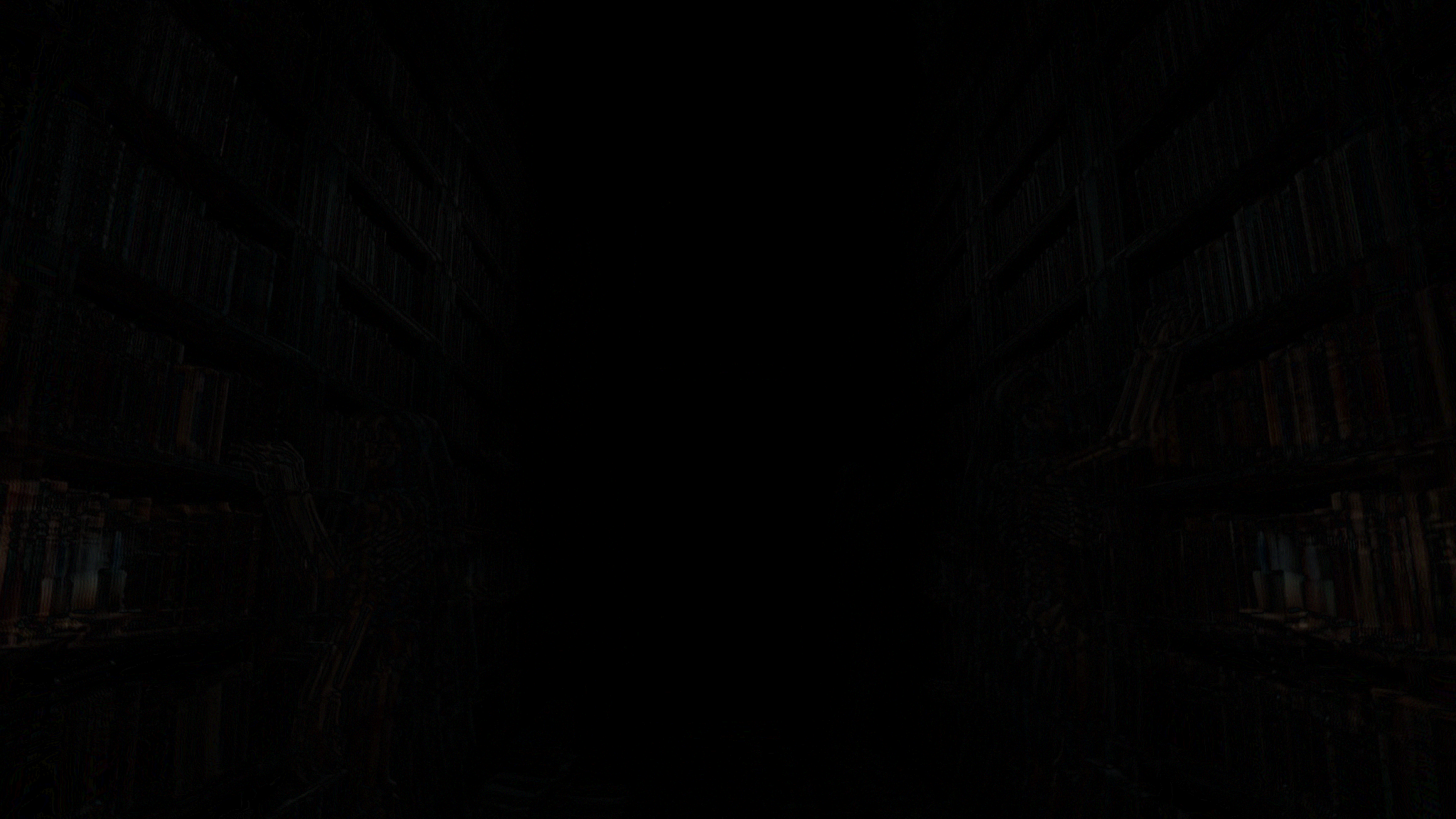
01.9 vs 01.8 absolute difference
SUPPORTING METRIC ONLY
camotion/tuning/analysis/01.9-vs-01.8-absdiff.png · 8× gain visualization · raw max channel difference 7
Difference is concentrated in the periphery. The protected destination is black (identical). Visual behavior remains the research target.
Checkpoint decision
Keep 01.8 Route-Preserved Exposure as the current Camotion baseline. Keep 01.9 as opt-in experimental evidence. Do not promote 01.9. Do not run Seedance/video on 01.9 based on this still. CameraMotionPlan v1 stays frozen. Default render() stays the continuous near-weight path. The later 01.10 diagnostic compositor ablation is recorded below.
CAMOTION 01.10 · SEPTEMBER 4, 2026
Ghost copies are already visible in strong exposure. The compositor hypothesis is not supported as their origin.
This entry is a chronological still-only Camotion diagnostic after 01.9. It is not a video experiment and not a new renderer version. CameraMotionPlan v1 and default render() were not changed. 01.8 Route-Preserved Exposure remains the current Camotion baseline. 01.10 is not promoted.
Diagnostic extraction, not a renderer change
METHOD
Control: 01.8 route-preserved Ghost Library still. Same source, plan, depth, outgoing 16-tap exposure, strength 0.08, medium/strong ratio 8/12, masks, destination protection, and route-preservation corridor. 01.9 adaptive integration was not used. Only change: save real 01.8 intermediates. Fixture metadata: tuning/01.10-compositor-ablation-config.json.
Actual 01.8 order from code: source → strong exposure → medium exposure → strong mask (gaussian, then expose) → medium mask → route preservation attenuates those masks → strong over (medium over pristine) → destination protection. Route preservation is a pre-composite mask attenuation. Effective weights w_s = S, w_m = M(1−S), w_p = (1−M)(1−S) sum to 1.0. The 01.10 final PNG is byte-identical to committed 01.8 (SHA-256 5f9c3bb8afb51cde59067f14349571cb2124db8c757307211f1b02912b5603d1).
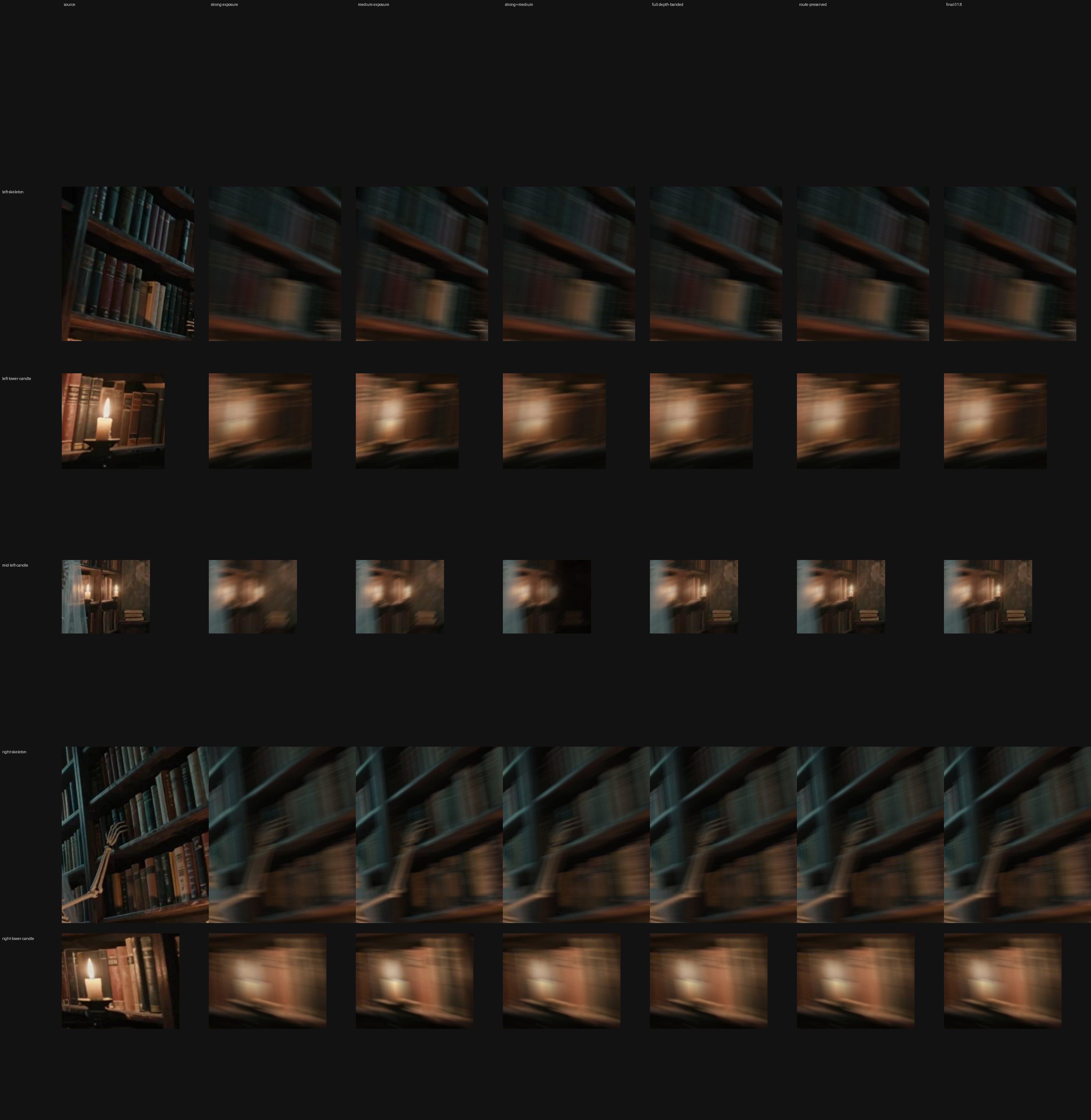
Targeted crops across compositor stages
CLASSIFICATION A
camotion/tuning/analysis/01.10/01.10-contact-sheet.png · source → strong → medium → strong+medium → full depth-banded → route-preserved → final 01.8
Same crops across stages. Discrete copies are already visible in strong exposure. Not a Seedance result. Not promoted.
Observed: on candles, shelf edges, and skeleton structure, discrete radial copies appear in strong exposure and independently in medium exposure. In the four foreground artifact crops, pristine effective weight above the diagnostic threshold 0.10 is 0.0, and strong+medium, full depth-banded, route-preserved, and final 01.8 are byte-identical. Destination bbox vs source is identical. Whole-image pre-route overlap at threshold > 0.10: strong∩medium 74.5%; all three 6.7%. Global full vs route MAE 0.46 is the corridor elsewhere. Destination protection MAE 0.0017.
Interpretation, not proof: first appearance is upstream of depth-layer compositing on this fixture (classification A). E is also supported: the pre-route depth-banded composite already contains the artifact, and route preservation does not create it in those foreground crops. The multi-layer compositor hypothesis is not supported as the origin of first appearance. Do not claim that the compositor can never matter, that the exposure operator’s exact mechanism is proven, that 01.9 is contradicted, or that Terran’s Photoshop renderer has been reproduced.
Strong exposure before compositing
COMPOSITOR HYPOTHESIS NOT SUPPORTED AS ORIGIN
camotion/tuning/analysis/01.10/01.10-01-strong-exposure.png · actual 01.8 strong exposed image, before depth compositing
Strong exposure alone already shows the repeated-object appearance. Later compositor stages are not required for first emergence.
Checkpoint decision
Keep 01.8 Route-Preserved Exposure as the current Camotion baseline. Keep 01.10 as diagnostic evidence. Do not promote 01.10. Do not call it a new renderer version. Do not run Seedance/video on 01.10 based on this still. CameraMotionPlan v1 stays frozen. Default render() stays the continuous near-weight path. The later 01.11 still-only exposure-operator characterization is recorded below.
CAMOTION 01.11 · SEPTEMBER 4, 2026
Dense sampling fills the local point streak. Structured Ghost Library copies remain. No 01.11 operator is promoted.
This entry is a chronological still-only Camotion diagnostic after 01.10. It is not a video experiment and not a new renderer version. CameraMotionPlan v1 and default render() were not changed. 01.8 Route-Preserved Exposure remains the current Camotion baseline. 01.11 is not promoted.
Exposure only, same 01.8 trajectory
METHOD
Research question: what spatial signal does Camotion’s current exposure operator actually produce, and which small operator families appear capable of a more continuous photographic streak along the same 01.8 trajectory? Control geometry: Ghost Library source, radial field, FoE (0.50, 0.56), strength 0.08, outgoing bilinear gather. Synthetic fixture: 256², FoE (0.50, 0.50), strength 0.40. No depth, compositor, masks, route preservation, or destination protection. 01.8 and 01.9 gather functions were reused. Fixture metadata: tuning/01.11-exposure-characterization-config.json.
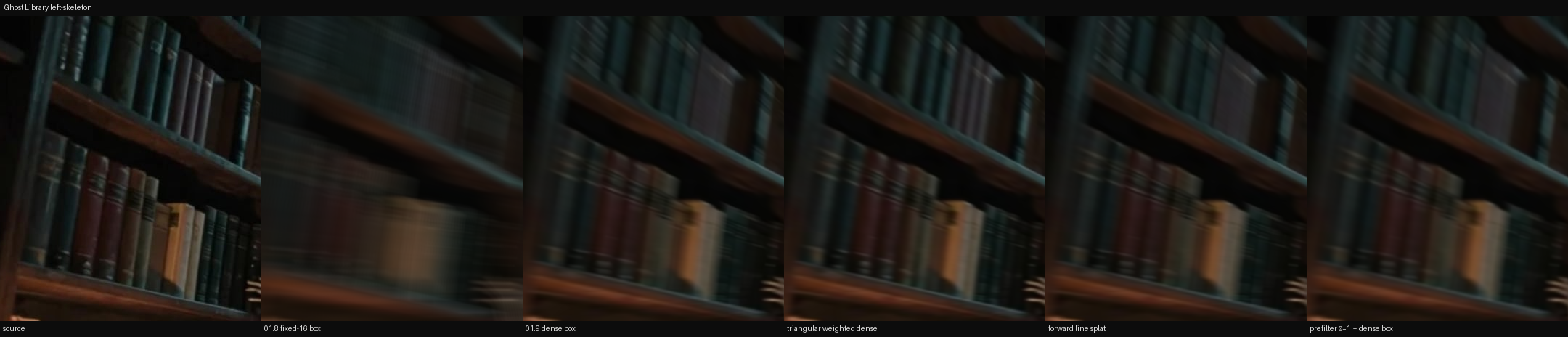
Operators: 01.8 fixed-16 equal-weight box; 01.9 dense equal-weight box (≤1 px); triangular weighted dense; forward line-splat (source-centric, not dest-gather); Gaussian σ=1 then 01.9 dense. Ghost Library 01.8 full strong exposure is byte-identical to the 01.10 strong-exposure intermediate. Other operators were characterized on padded 01.10 artifact crops.
Synthetic primitives. 01.8 is discrete beads/steps. 01.9 fills the local point path into a continuous, rippled streak. Not a Seedance result. Not promoted.
Observed: 01.8 fixed-16 contains discrete sampling artifacts. 01.9 dense ≤1 px sampling converts the local point response into a continuous, though rippled, streak (in-bounds active fraction 1.0 versus 0.62 for 01.8; 01.8 still has zeros between taps). The synthetic point at (32,32) with strength 0.40 smears out of frame; far-end forward-splat brightness includes edge clamp. Crop/operator energy stayed comparable; candidates did not look better by going darker.
Left-skeleton crop. Structured features still read as transformed copies under dense gather. Prefilter reduces copy readability by softening source structure. Not promoted.
Observed: structured Ghost Library features continue to read as transformed copies. Triangular temporal weighting did not materially reduce those copies. Forward line-splat is a different operator, not a better reconstruction of the existing destination-gather integral. Sigma=1 prefiltering was the only tested family that reduced copy readability, and did so by softening source spatial structure. No tested 01.11 operator produced a clearly superior continuous photographic streak while preserving structured content.
Interpretation, not proof: classifications A, E, and F. Sampling density is not the remaining problem. Repeated appearance of structured content is emerging from integrating transformed copies along a long single-frame path. Prefiltering is a bandwidth effect, not a chosen intervention. Do not claim that sparse sampling can never matter, that prefiltering is a renderer fix, or that Terran’s Photoshop renderer has been reproduced.
Checkpoint decision
Keep 01.8 Route-Preserved Exposure as the current Camotion baseline. Keep 01.11 as diagnostic evidence. Do not promote 01.11. Do not promote any 01.11 candidate. Do not call it a new renderer version. Do not run Seedance/video on 01.11 based on this still. CameraMotionPlan v1 stays frozen. Default render() stays the continuous near-weight path. The later 01.12 still-only baked-exposure operating window is recorded below.
CAMOTION 01.12 · SEPTEMBER 4, 2026
No useful pristine baked-exposure window. The motion cue and structured copies appear together. Exposure-operator tuning is closed.
This entry is a chronological still-only Camotion diagnostic after 01.11. It is not a video experiment and not a new renderer version. CameraMotionPlan v1 and default render() were not changed. 01.8 Route-Preserved Exposure remains the current Camotion baseline. 01.12 is not promoted. Sigma=1 is a diagnostic control only.
Fixed-16 gather, four strengths, two bandwidths
METHOD
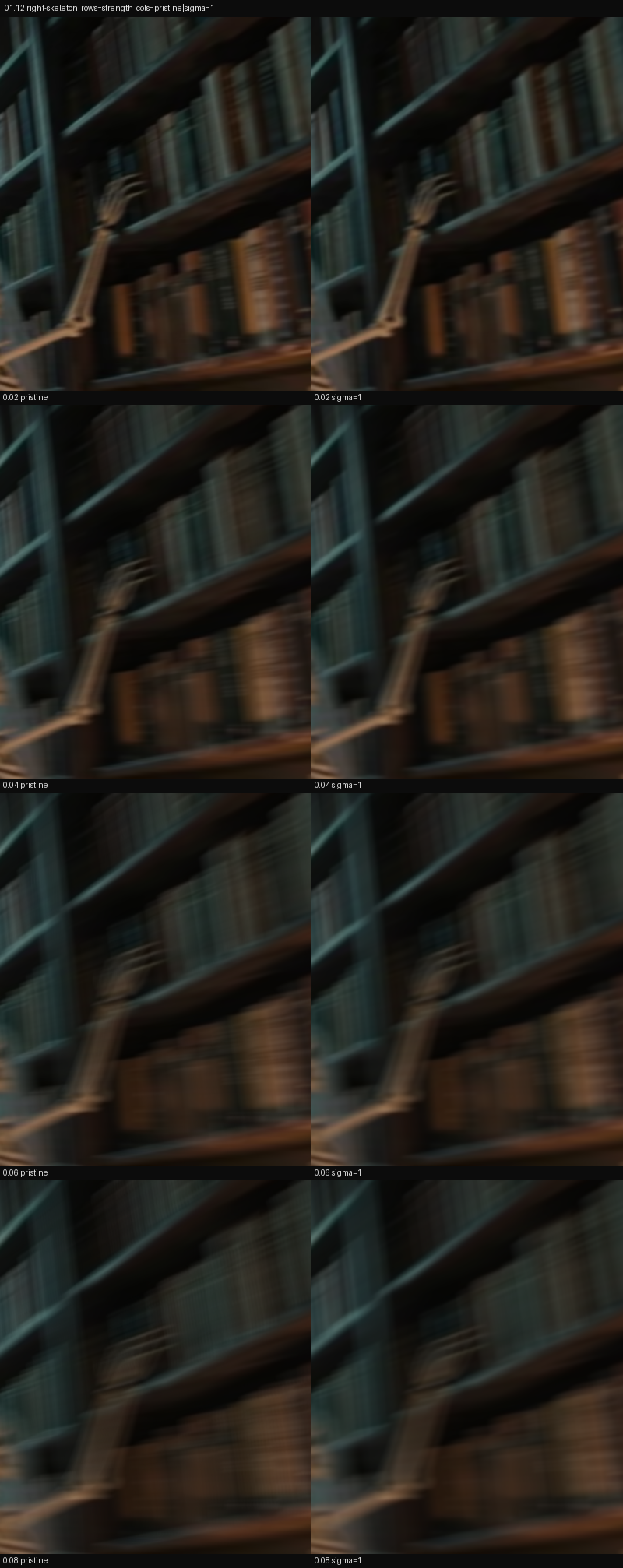
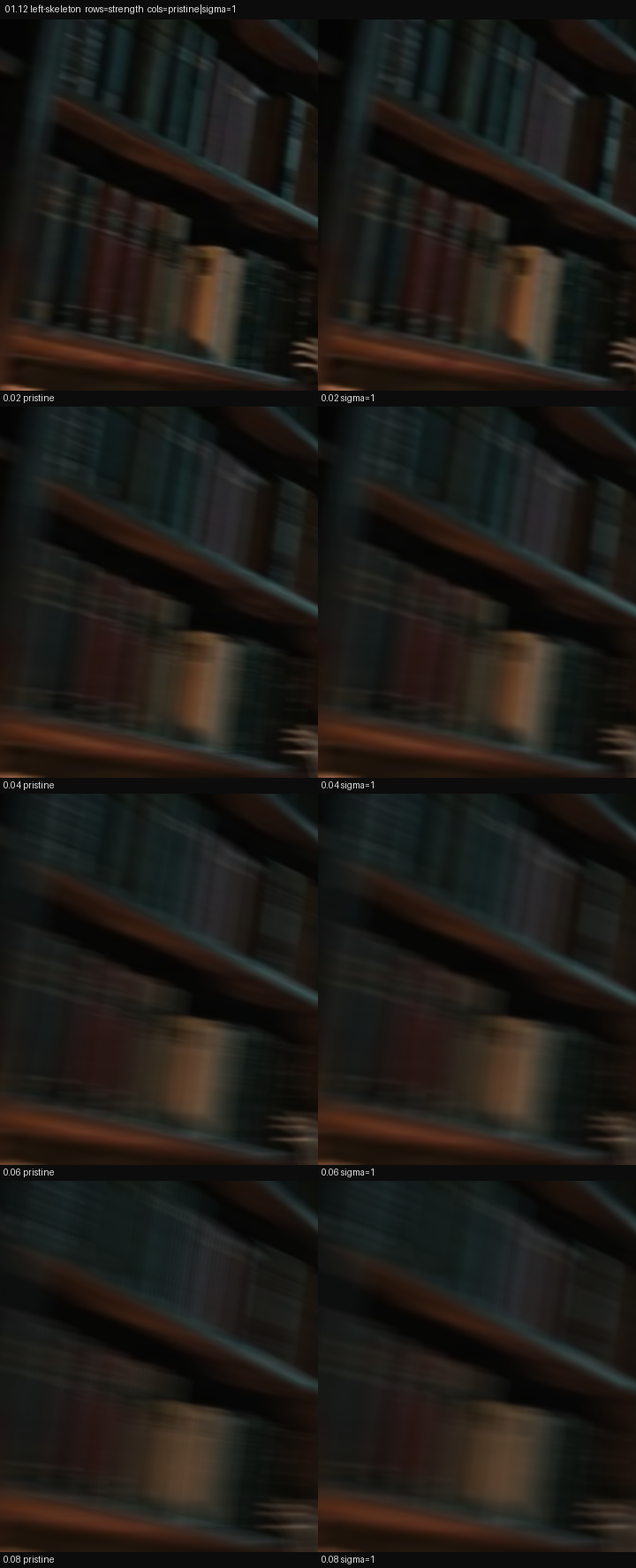
Research question: is there a useful baked-exposure regime where displacement is strong enough to provide a meaningful directional motion cue and structured scene content does not develop objectionable repeated-object appearance? Operator: existing 01.8 apply_multisample_exposure, N=16, outgoing dest-gather. Same Ghost Library source, radial field, FoE (0.50, 0.56). Strengths 0.02 / 0.04 / 0.06 / 0.08. Bandwidth: pristine vs sigma=1 Gaussian diagnostic control. No compositor, masks, route, or destination protection. Not parameter optimization. Fixture metadata: tuning/01.12-operating-window-config.json.
Whole-image path length scales linearly: mean 12.6 / 25.2 / 37.8 / 50.4 px. 0.08 pristine is byte-identical to the 01.10 strong-exposure intermediate.
Right-skeleton crop. 0.02 is a weak cue. 0.04 already shows readable finger copies. 0.06–0.08 are strong cues with objectionable duplication. Sigma=1 softens copies by destroying source detail. Not promoted.
Observed: 0.02 preserved structured content reasonably well but produced only a weak directional motion cue, especially near the FoE. 0.04 produced a meaningfully useful peripheral directional cue, but recognizable repeated structure was already clearly present in fingers, flames, and other artifact features. 0.06 and 0.08 produced strong directional cues but objectionable structured-content duplication. Therefore no useful pristine-source operating window was observed: the motion cue becomes useful at approximately the same point that structured duplication becomes objectionable.
Interpretation, not proof: classification C + D. Sigma=1 reduced copy readability across strengths by reducing source spatial detail. It did not establish a sharp-detail operating window. Prefiltering remains diagnostic evidence and is not a proposed Camotion pipeline change. The 01.12 stop rule applies: do not search additional strengths, sigma values, shutter weightings, integration kernels, or compositors. This closes the current exposure-operator tuning branch.
Left-skeleton / bookshelf crop. Same strength boundary: useful cue and objectionable copies meet around 0.04. Not promoted.
Checkpoint decision
Keep 01.8 Route-Preserved Exposure as the current Camotion baseline. Keep 01.12 as diagnostic evidence. Do not promote 01.12. Do not promote any 01.12 condition. Do not add sigma=1 to Camotion. Do not call it a new renderer version. Do not run Seedance/video on 01.12 based on this still. CameraMotionPlan v1 stays frozen. Default render() stays the continuous near-weight path. The current exposure-operator tuning branch is closed. The next untested question is above the baked-exposure primitive: how can Camotion communicate useful camera direction/motion to the video model without integrating a long trajectory of recognizable scene structure into a single shooting frame? Do not choose or implement a replacement mechanism yet. Do not prematurely promote motion fields, auxiliary conditioning, overlays, multiple frames, or another specific representation into the architecture. Do not begin that experiment from this checkpoint.